Why General LLMs Are Failing: The Shift Toward Domain-Specific Language Models
Large Language Models (LLMs) like GPT, Gemini, and others have captured global attention with their ability to generate human-like text, write code, and answer complex questions. LLMs are often positioned as general-purpose intelligence systems capable of handling almost any kind of task.
The Illusion of “General Intelligence”
Large Language Models (LLMs) like GPT, Gemini, and others have captured global attention with their ability to generate human-like text, write code, and answer complex questions. LLMs are often positioned as general-purpose intelligence systems capable of handling almost any kind of task.
But in practice, this promise is starting to crack.
Across industries like finance, healthcare, law, and engineering, organizations are discovering a critical limitation: general LLMs are not reliable enough for specialized, high-stakes tasks. This realization is driving a major shift toward Domain-Specific Language Models (DSLMs) AI systems trained deeply within a particular field.
The Core Problem: Breadth Over Depth
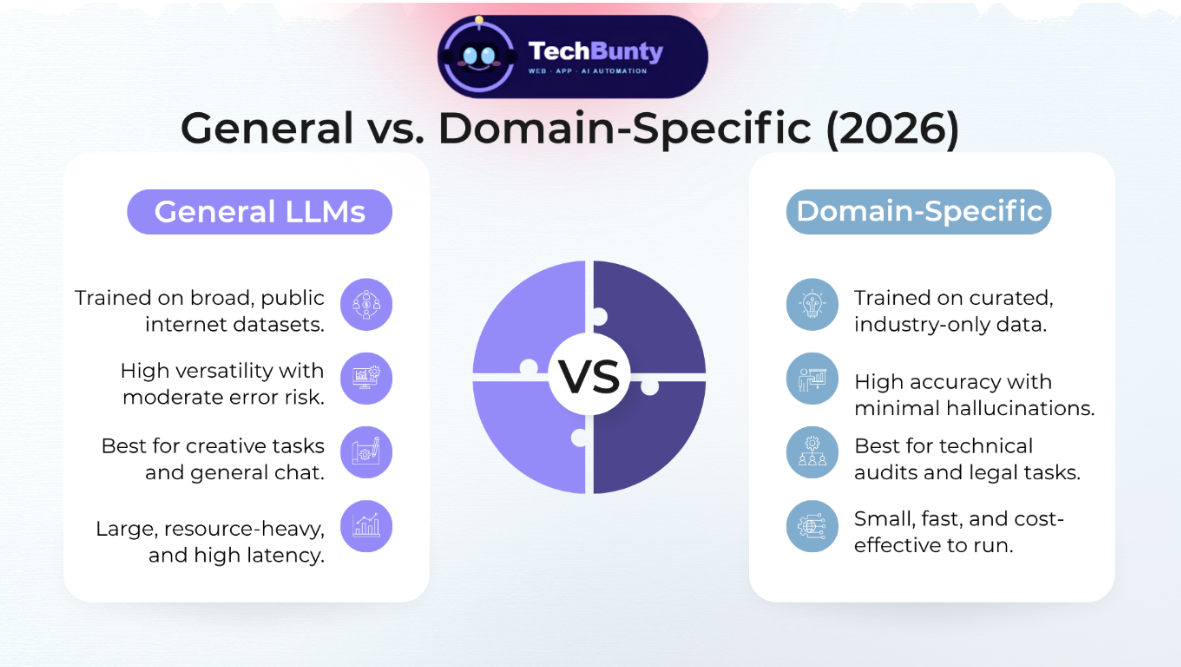
General LLMs are trained on vast datasets scraped from the internet books, websites, forums, and code repositories. This gives them broad knowledge, but not deep expertise.
Think of them as a “jack of all trades.” They can discuss almost anything but often lack the precision required for specialized domains.
Research shows that general models struggle because they lack exposure to domain-specific terminology, logic, and structured knowledge systems (ScienceDirect).
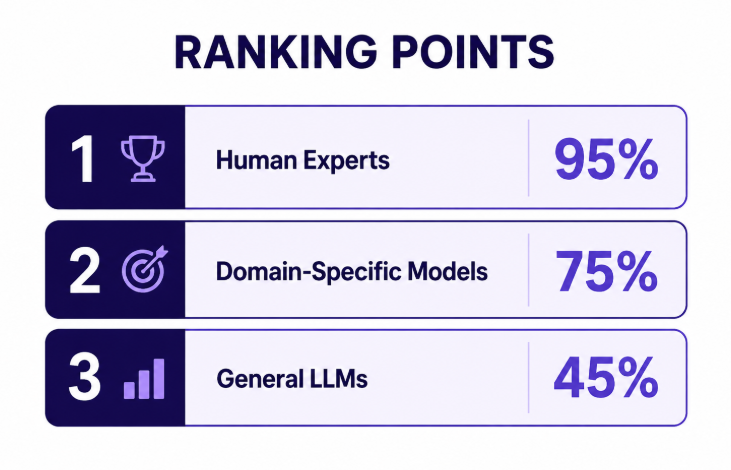
Example
This gap becomes dangerous in regulated or technical fields.
|
Feature
|
General LLMs (e.g., GPT, Gemini)
|
Domain-Specific LLMs (DSLMs)
|
|---|---|---|
|
Knowledge Scope
|
Broad, "jack-of-all-trades" knowledge across many subjects.
|
Deep, narrow expertise focused on a single industry (Law, Med, Finance).
|
|
Reliability
|
Higher risk of "hallucinations" in technical contexts.
|
High precision; designed for accuracy in high-stakes environments.
|
|
Terminology
|
Uses common language; may struggle with nuanced technical jargon.
|
Masters complex, industry-specific vocabulary and technical nuances.
|
|
Data Source
|
Trained on massive, public internet datasets.
|
Trained on proprietary, curated, and peer-reviewed professional data.
|
|
Primary Use Case
|
Creative writing, general brainstorming, and basic tasks.
|
Clinical support, legal analysis, and complex engineering tasks.
|
Why it happens
Real-world impact
In high-stakes environments, even a small error rate is unacceptable.
Lack of Domain Logic and Context
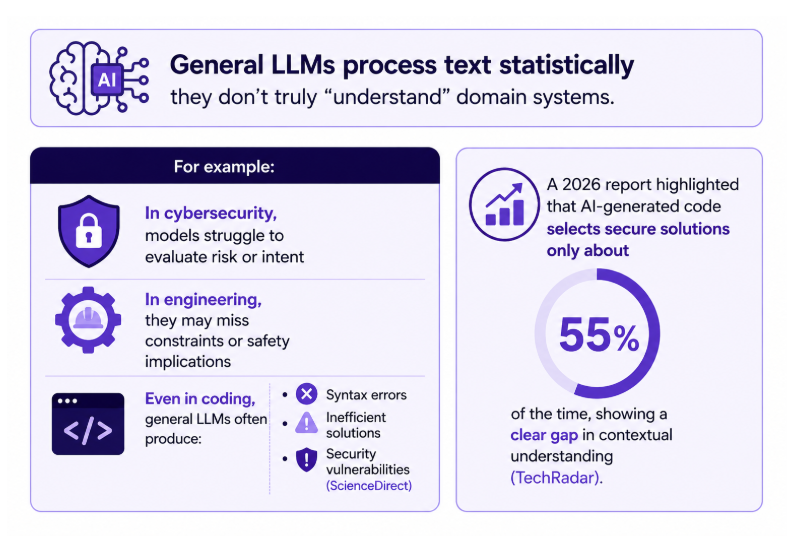
General LLMs process text statistically; they don’t truly “understand” domain systems.
Example
Even in coding, general LLMs often produce
A 2026 report highlighted that AI-generated code selects secure solutions only about 55% of the time, showing a clear gap in contextual understanding (TechRadar).
The Hidden Limitation
General LLMs are trained on public, generic datasets, but real-world enterprise problems rely on:
- Proprietary data
- Internal workflows
- Industry-specific regulations
This mismatch creates a major failure point.
Recent industry analysis shows that general models fail to capture organization-specific knowledge, limiting their real-world ROI (TechRadar).
Inconsistency and Lack of Reliability
Another critical issue: non-deterministic behavior.
General LLMs can
This unpredictability makes them difficult to deploy in production systems that require consistency and auditability.
Why Domain-Specific Models Are Winning
Domain-Specific Language Models (DSLMs) are designed to solve these exact problems.
They are typically built by:
- Fine-tuning base LLMs on specialized datasets
- Using Retrieval-Augmented Generation (RAG)
- Incorporating structured domain knowledge
Key advantages:
2. Reduced Hallucination
With curated datasets, DSLMs generate more grounded outputs.
3. Better Compliance
They can be aligned with:
Industry regulations (IFRS, HIPAA, etc.)
Organizational policies
4. Context Awareness
They understand:
Terminology
Workflows
Domain-specific constraints
5. Cost Efficiency
Smaller, specialized models can outperform large general models at lower cost, especially in repetitive tasks.
The Rise of Hybrid AI Architectures
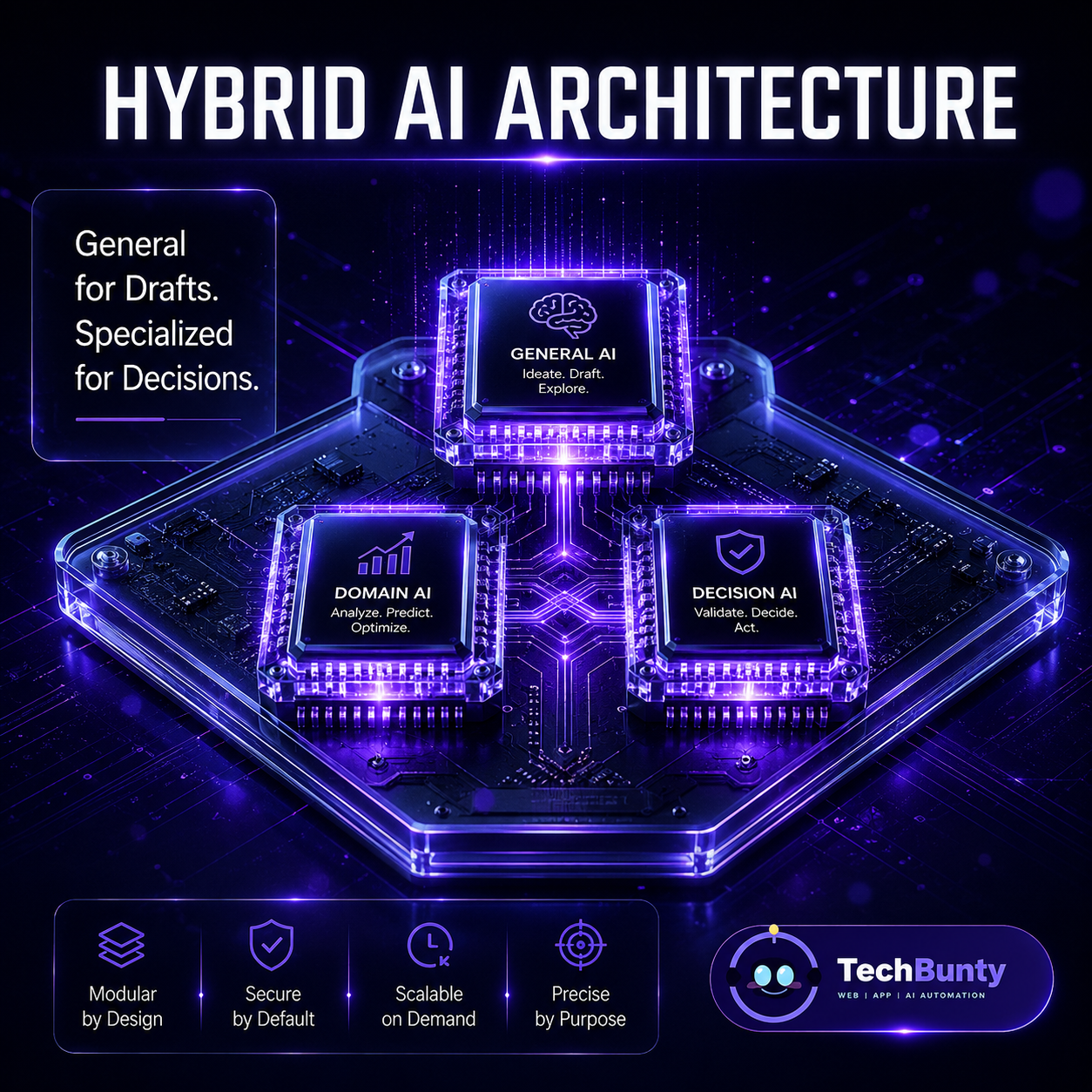
The future is not purely “general vs specialized” but it’s hybrid.
Emerging systems combine
This layered approach allows organizations to
Research highlights hybrid paradigms as the next evolution in LLM deployment (ResearchGate).
When General LLMs Still Work
Despite their limitations, general LLMs are still valuable for:
- Content creation
- Brainstorming
- General Q&A
- Early-stage prototyping
They excel in low-risk, broad tasks where precision is not critical.
From “Big Models” to “Right Models”
The industry is reaching a key realization:
Bigger models are not always better, better data and specialization are.
Analysts predict that over 50% of enterprise AI models will be domain-specific in the near future, reflecting a major strategic shift (TechRadar).
ROI of Specialization
Which one is cheaper to use, a general model or build a DSLM? While the initial cost of a Domain-Specific Language Model(DSLM) is higher, the long- term ROI is found in lower inference costs and higher accuracy.
|
Metric
|
General LLM
|
Domain-Specific Model (DSLM)
|
|---|---|---|
|
Accuracy (Niche)
|
65–75%
|
95%+
|
|
Inference Cost
|
High (Resource intensive)
|
Low (Domain-optimized)
|
|
Expertise Level
|
Generalist
|
Specialist
|
5 Key Reports on general LLMs
In 2026 regarding the shift from general LLMs to Domain-Specific Language Models (DSLMs):
1. NVIDIA and ServiceNow: The Rise of Specialized Agents
May 5, 2026 NVIDIA CEO Jensen Huang and ServiceNow CEO Bill McDermott announced an expanded partnership focusing on “Specialized Autonomous AI Agents.” The news highlights a shift toward domain-specific skills and open models that allow agents to operate within complex enterprise workflows with high security and consistency.
2. SAP’s €1 Billion Bet on Tabular Foundation Models
May 6, 2026 SAP announced its intent to acquire Dremio and Prior Labs, committing €1 billion to develop “Tabular Foundation Models” specifically for structured business data. This move aims to eliminate the limitations of general AI by providing deeply contextualized, industry-specific intelligence for enterprise decision-making.
3. LTM and Uniphore Partner for Domain-Specific AI
May 4, 2026 LTM Limited (formerly LTIMindtree) and Uniphore have partnered to scale specialized AI across BFSI (Banking, Financial Services, and Insurance), manufacturing, and media. The collaboration focuses on Small Language Models (SLMs) and domain-specific expertise to handle compliance-heavy workflows like contract intelligence.
4. Gartner Report: GenAI as a Precision Tool
March 2, 2026 A major industry analysis by Gartner suggests that DSLMs are breaking the “AI value barrier.” The report finds that specialized models offer up to 50% lower development costs and higher reliability in business-critical tasks compared to generic LLMs.
5. The End of the "One Model Fits All" Era
March 19, 2026 Recent industry analysis notes that 2026 marks the point where AI shifts from “conversational novelty” to an “operational backbone.” The report emphasizes Vertical LLMs trained on proprietary, domain-specific data as the only way to achieve the precision required for high-stakes environments.
Precision Over Generalization
General LLMs sparked the AI revolution but they are not the endgame.
Their limitations, hallucination, lack of domain depth, inconsistency, and data mismatch make them unsuitable for many real-world applications.
Domain-Specific Language Models represent the next phase:
The future of AI isn’t about building one model that does everything.
It’s about building the right model for the right problem.
Stop chasing the “biggest” model and start prioritizing the “most relevant” data. General LLMs are for inspiration; Domain-Specific Models are for execution.
The Strategy: Use General AI for your first draft, but never for the final decision. In high-stakes fields, precision is your only real currency.
Table of Contents
ToggleReady to move beyond generic AI?
At Tech Bunty, we help you build domain-specific AI solutions that deliver real accuracy, compliance, and business impact.
Latest Post
- All Posts
- AI
- AI Agents
- AI Automation
- Anthropic
- App Development
- Cybersecurity
- LLMs
- Physical Ai
- Web Development