
The Rise of AI Agents: Why 2026 Marks the Shift to Autonomous Productivity
For the last of the decade, we have been stuck in a cycle. We give instructions; the software responds. That’s it. Even the most advanced AI systems have essentially just been high-end assistants. This software model is not working in 2026.
Table of Contents
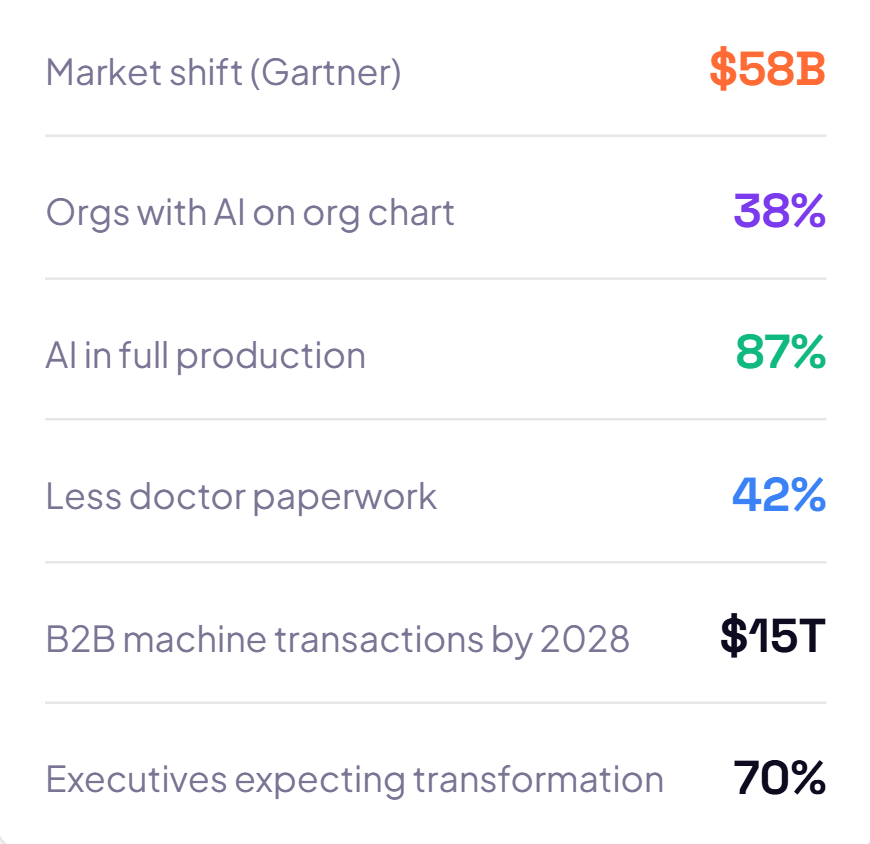
ToggleKey Numbers
Moving Beyond Assistance
Traditional AI systems were built around prompts. You asked a question, generated content, or requested analysis and the system delivered a result.
AI agents operate differently.
They are designed around objectives instead of prompts. Give them a goal, and they can:
This transforms AI from a passive utility into something closer to a digital operator.
Why This Shift Is Happening Now
The idea of autonomous systems isn’t new. What’s changed is that the underlying technology has finally caught up with the ambition.
01
Smarter Reasoning Capabilities
02
Expanded Working Memory
Agents can now retain and use context across longer workflows, making them far more consistent in execution.
03
Real Tool Integration
Instead of operating in isolation, AI can now connect with:
- Business software
- Databases
- APIs
- Internal systems
This connectivity is what enables real-world impact, not just theoretical capability.
04
Improved Stability Over Time
Earlier systems struggled with long tasks. In 2026, agents can sustain performance across extended workflows, making them viable for business operations.
From Single Tools to Intelligent Systems
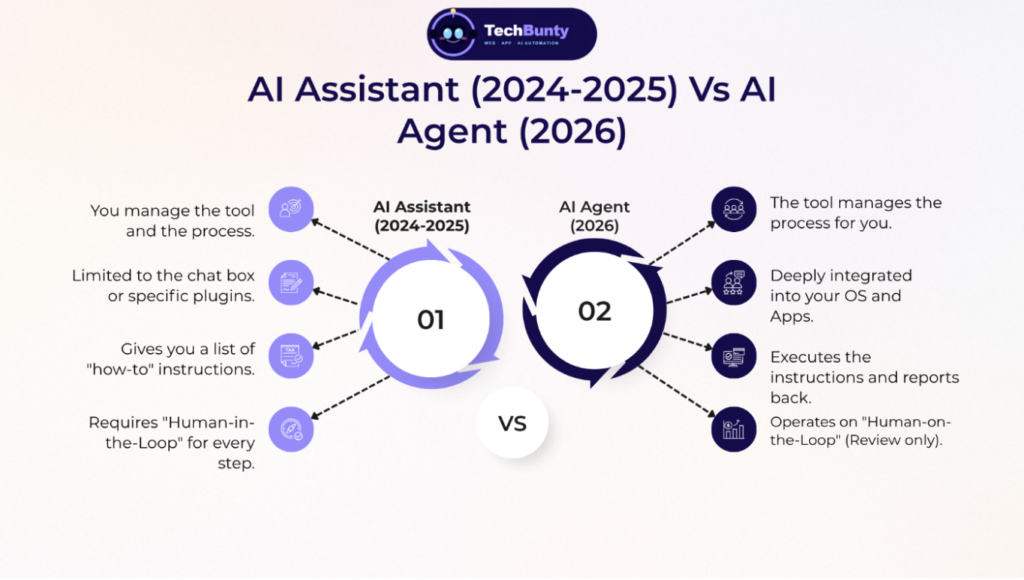
A major misconception is that AI agents are just “better chatbots.” In reality, they represent a shift toward system-level intelligence.
Organizations are no longer deploying AI as isolated features. They are building environments where:
- Multiple agents handle different responsibilities
- Tasks are distributed automatically
- Outputs feed into continuous workflows
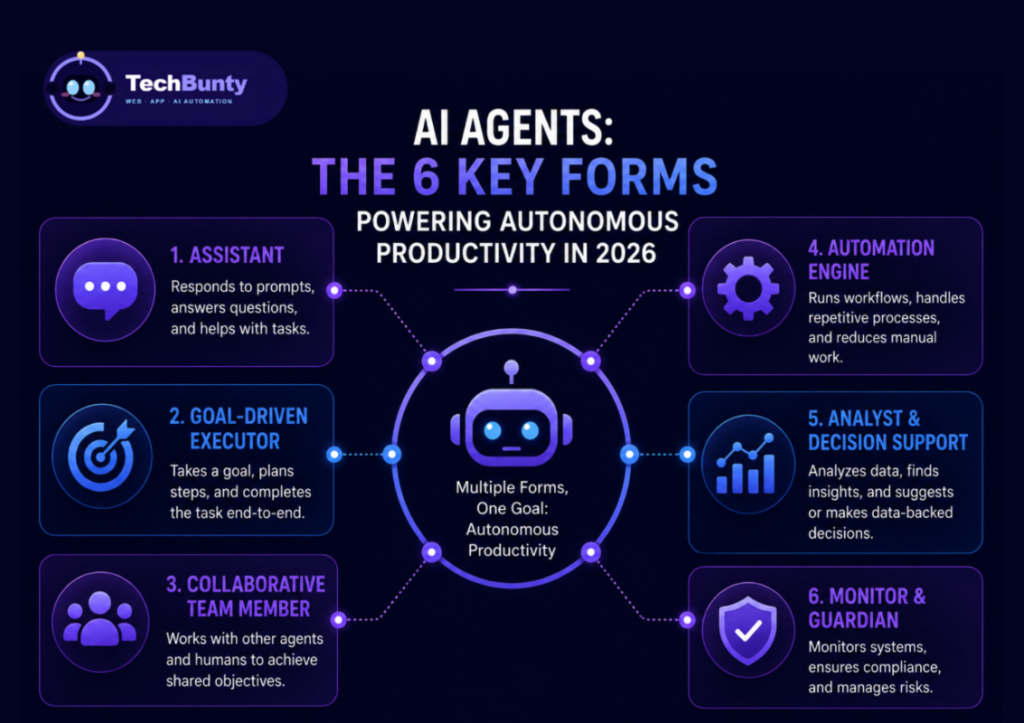
The Emergence of AI “Teams”
One of the most powerful developments is the use of multiple agents working together.
Instead of relying on a single system, companies are structuring AI like a team:
- One agent gathers information
- Another processes and executes
- A third reviews and validates outcomes
Real Impact Across Workflows
Autonomous agents are already reshaping how to perform a task efficiently:
| Industry | What's Changing |
|---|---|
|
In Finance |
Processes like risk evaluation, reporting, and compliance checks are increasingly automated through structured AI workflows.
|
|
In Customer Operations
|
AI systems can manage interactions, resolve issues, and even make optimized decisions on behalf of users.
|
|
In Technology Teams
|
Development workflows from writing code to testing and deployment are being partially handled by AI agents, reducing turnaround time significantly. |
Redefining Human Roles
As agents take over execution, human involvement is shifting upward.
Instead of focusing on repetitive or operational tasks, people are now:
Accessibility Is Accelerating Adoption
Another reason 2026 stands out is accessibility.
You no longer need deep technical expertise to use or deploy AI agents with the emergence of low-code and no-code environment:
- Business users can create workflows
- Teams can experiment quickly
- Organizations can scale without heavy engineering overhead
This ease of use is fueling rapid adoption across industries.
Challenges That Can't Be Ignored
Despite the momentum, autonomous systems are not without risks. The goal is not to remove humans entirely, but to rebalance responsibility.
Inconsistency
Oversight Gaps
Governance Concerns
Structural Shift
A Structural Shift in Productivity
What makes 2026 different isn’t just better technology, it’s a different way of thinking about work.
- Task execution → to goal execution
- Individual tools → to connected systems
- Human-led workflows → to AI-driven processes
This is not a temporary trend. It’s a structural transformation.
5 Reports That Prove 2026 is the Year of Agents
The hype of 2025 is over. 2026 is officially being called “The Year of Agents” by industry leaders like Microsoft and Gartner. Here are 5 pieces of latest news confirming this shift.
1. Gartner: The $58 Billion Productivity Shake-up
2. Proofpoint: The Gap Between AI Rollout and Security
3. Healthcare's "Care Orchestration" Revolution
4. The Rise of "Agent Engine Optimization" (B2B Procurement)
5. Microsoft and the "Chapter Two" of AI
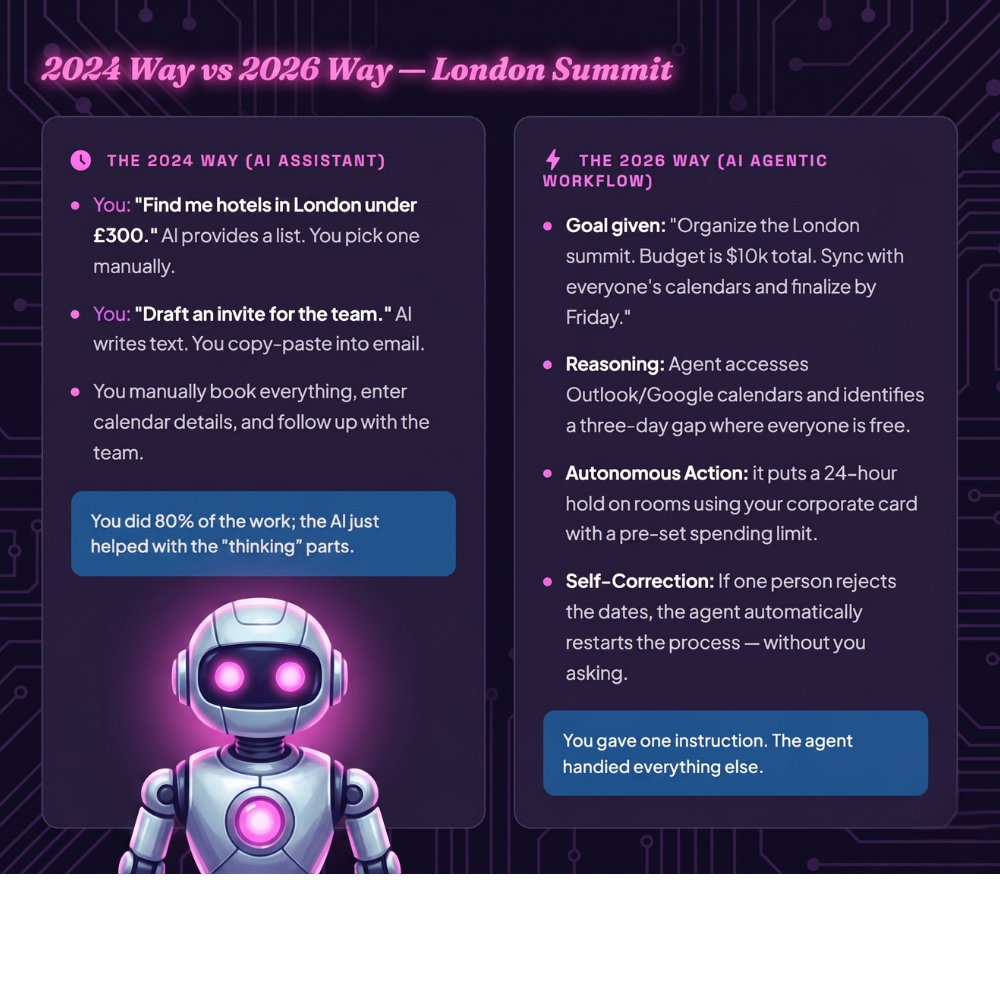
The Practical Example: "The Relentless Travel Planner"
To understand why 2026 is being hailed as the “Year of Autonomous Productivity,” we have to look at the shift from AI Assistants (tools you talk to) to AI Agents (tools that work for you).
In 2024 and 2025, you likely used AI to write an email. In 2026, an AI Agent handles the entire project that required the email in the first place.
Imagine you need to organize a 3-day business summit in London for 10 people next month.
Why 2026 is the Turning Point
The technology has moved past “chatting” because of three major upgrades that matured this year:
Multi-Step Reasoning
Earlier AI would get “lost” in long tasks. 2026 agents use chain-of-thought processing to break a giant goal (like “Launch this marketing campaign”) into 50 tiny sub-tasks, executing them one by one in the background.
"Computer Use" & API Integration
Agents are no longer stuck inside a chat box. They can now “see” and “click” on your screen or connect directly to enterprise software (Salesforce, SAP, GitHub) to move data between them, acting as a digital glue between apps that don’t normally talk to each other.
Governed Autonomy
Organizations finally trust agents because of “Guardrail Models.” Companies now deploy agents with strict permissions: for example, an agent can “Draft and Schedule” but never “Send” without a human click, or it has a $500 autonomous spending limit.
Practical Use Cases in 2026
The technology has moved past “chatting” because of three major upgrades that matured this year:
| Industry | The Autonomous Shift |
|---|---|
|
Sales |
Agents don’t just find leads; they research the lead’s LinkedIn, find a mutual connection, and draft/send a personalized reach-out. |
|
Coding |
An agent monitors your GitHub. When a bug is reported, it writes the fix, runs the tests, and submits a Pull Request for you to review. |
|
HR |
Onboarding agents automatically provision laptops, set up Slack accounts, and schedule “Coffee Chats” for new hires based on team availability. |
In short: 2026 is the year we stop treating AI as a search engine and start treating it as a digital employee.
AI Agents Aren't Just a Trend: They're a Shift
AI agents aren’t just a trend but they are a shift in how work gets done. Start small, focus on real workflows, and keep human oversight in place.
The real advantage comes from using AI strategically, not just adopting it.
The real breakthrough is not that machines can do more work. It’s that they can now take ownership of work within defined boundaries.