
AI with a Body: The Breakthroughs in Physical AI You Missed This Year
Artificial intelligence is no longer limited to screens. In 2025–2026, AI stepped into the physical world through machines that can move, see, and interact. For years, AI was like a brain without a body. That limitation is now disappearing.
Table of Contents
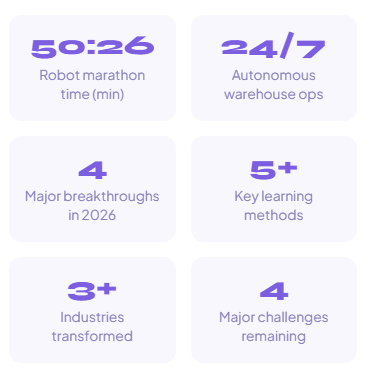
ToggleKey Stats
Don't Get Left Behind
Follow TechBunty for the latest updates, trends, and breakthroughs in Physical AI and beyond.
Key Points:
- AI is shifting from digital to physical
- Real-world interaction is increasing
- Industries are adopting this technology
- Future AI will focus on action, not just data
What Is Physical AI?
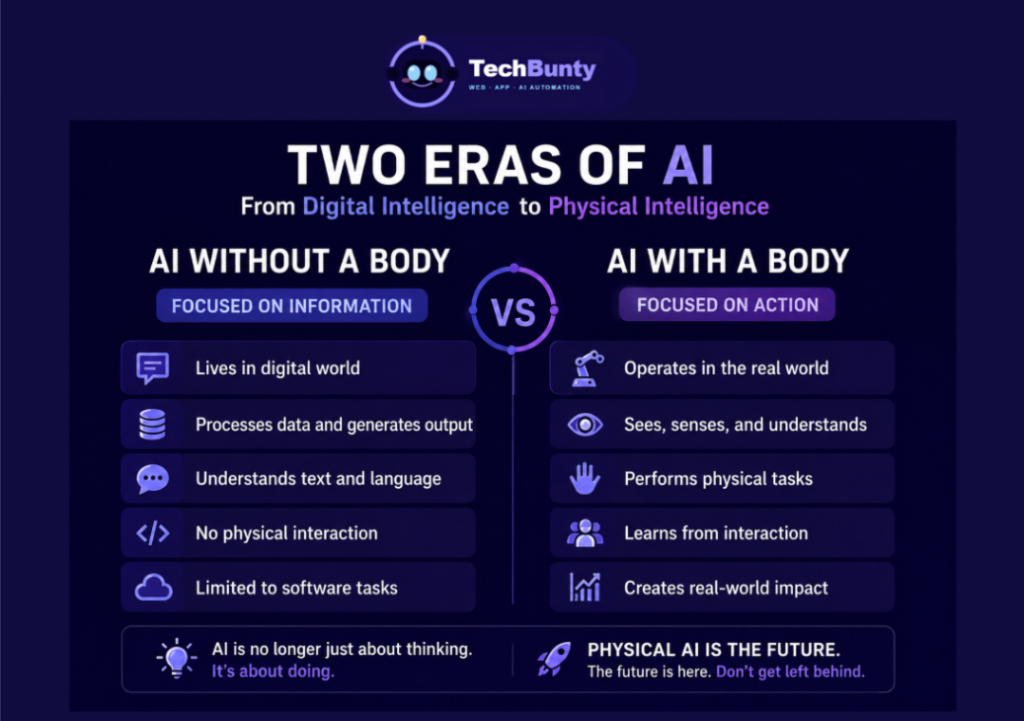
Physical AI refers to AI systems inside machines such as robots, drones, and autonomous systems. These systems must understand and interact with the real world, not just process data.
This shift is known as Physical AI or Embodied AI. Instead of just generating text or images, AI can now perform real-world tasks. This makes them far more complex than traditional AI.
“For years, AI was like a brain without a body. That limitation is now disappearing.”
Physical AI systems can perform a range of complex tasks that were previously impossible for machines:
Why This Year Was a Breakthrough
The progress in 2025–2026 didn’t happen by chance. Multiple technologies advanced at the same time. Together, these innovations made physical intelligence practical.
- Faster AI models
- Better hardware and sensors
- Improved robotics design
- Advanced simulations
- Multimodal intelligence
Rise of Humanoid Robots
Human spaces are built for human bodies. Robots with similar shapes can:
- Use tools
- Open doors
- Climb stairs
- Work in existing environments
This reduces the need for redesigning infrastructure.
Breakthrough in Dexterity
Robots are now performing tasks that require precision and coordination.
- Playing musical instruments
- Cooking tasks like chopping and cracking eggs
- Handling delicate objects
- Performing assembly work
This shows major improvement in fine motor skills.
Robots Are Becoming Collaborative
Modern robots are no longer working alone. They can now coordinate with other robots and humans.
- Real-time adaptation
- Visual coordination
- Shared task execution
This enables teamwork instead of isolated automation.
Learning Like Humans
Physical AI systems are learning in new ways that mimic human learning.
This makes robots more flexible and intelligent.
Sim-to-Real Training
Robots are trained in virtual environments before operating in the real world.
- Faster training
- Lower cost
- Reduced risk
- Scalable learning
This approach is accelerating development significantly.
Role of Language Models in Robotics
Large language models are now helping robots understand and plan tasks.
What Robots Can Do Now
- Follow natural language instructions
- Break tasks into steps
- Make decisions
Example: “Clean the kitchen” can be executed without manual programming.
Expansion Beyond Factories
Physical AI is moving into multiple industries beyond manufacturing. Robots are becoming part of daily life.
Rehabilitation assistance
Hospital logistics
Inventory management
Warehouse automation
Organizing
Companionship
Multimodal Intelligence
Modern AI systems combine multiple inputs at once ; vision, audio, touch, motion, and language. This improves decision-making and performance significantly.
Global Competition Is Growing
Countries are investing heavily in Physical AI. Key trends include rapid development in Asia, standardization of robotics, and increased government support. This signals long-term industry growth.
Major Challenges
Despite progress, several problems remain that the industry must solve before Physical AI reaches its full potential.
Energy Limitations
Robots require large amounts of power, and battery technology is still limited.
Safety Concerns
Errors in physical systems can be dangerous, unlike software mistakes.
Real-World Complexity
The physical world is unpredictable and difficult for machines to fully understand.
Data Shortage
Training data for physical tasks is limited compared to digital data.
Impact on Jobs
Physical AI will change how work is done through automation of repetitive tasks, increased efficiency, and human-robot collaboration. Full replacement of humans is unlikely in the near term.
Four Breakthroughs That Changed Everything
In May 2026, “Physical AI” the technology that gives AI a body to interact with the real world has moved from lab experiments to industrial and consumer reality.
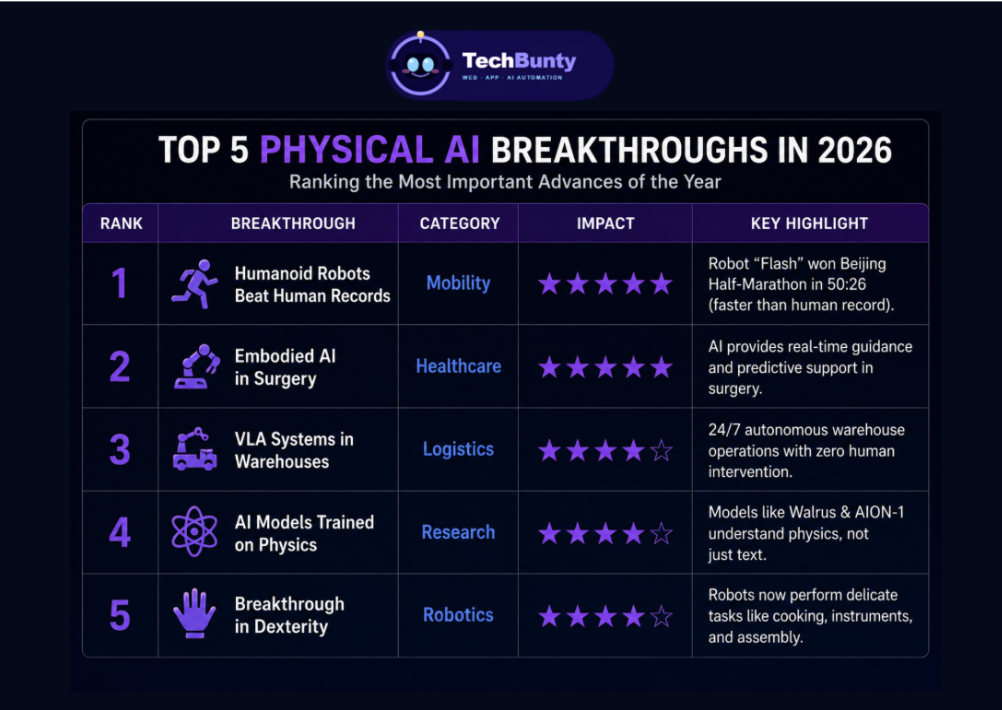
Here are the four most significant news breakthroughs and the official reports documenting them:
1. Humanoid Robots Break Human World Records
In a landmark event for mobile Physical AI, a humanoid robot named “Flash” won the 2026 Beijing E-Town Half-Marathon. It completed the race in 50 minutes and 26 seconds, nearly seven minutes faster than the human world record. This demonstrates that AI-driven motion control and “Edge AI” (processing data on the robot itself) have finally surpassed human physical efficiency.
The robot operated in a fully autonomous navigation mode, reacting to terrain and obstacles in real-time.
2. The Launch of “Embodied” Surgical AI
Researchers at King’s College London have introduced Embodied AI for the operating room. Unlike traditional surgical robots that are strictly tools controlled by humans, these systems use “Physical AI” to sense, coordinate, and act autonomously during surgery. They can provide real-time guidance and even perform predictive “cause-and-effect” visualizations to show surgeons the outcome of a move before they make it.
This shift aims to move surgery from human clinical expertise to a data-driven, personalized approach.
3. VLA Systems Take Over Global Warehousing
In May 2026, the robotics firm Nomagic expanded its partnership with major European retailers to deploy Vision-Language-Action (VLA) systems. These robots no longer follow fixed code; they “understand” their physical environment through natural language and visual cues, allowing them to run entire warehouse shifts during nights and Sundays with zero human intervention.
This is the first large-scale commercial proof that robots can adapt to changing inventory without being manually reprogrammed.
4. AI Models Trained on Physics, Not Just Words
The Polymathic AI collaboration, involving researchers from the University of Cambridge, recently released foundational models called Walrus and AION-1. Unlike ChatGPT, which is trained on text, these models are trained on real-world physics datasets. This allows the AI to “understand” gravity, fluid dynamics, and astronomical motion, providing a “brain” for physical systems to navigate the universe more accurately.
These models allow AI to apply “common sense physics” to completely new problems, like how a robot should handle a fragile object it has never seen before.
Comparison of 2026 Breakthroughs
| Breakthrough | Primary Actor | Domain | Impact |
|---|---|---|---|
|
Robotic Speed
|
Honor Smart Tech
|
Athletics/Mobility
|
Surpassed the human marathon record.
|
|
Surgical Autonomy
|
King’s College London
|
Healthcare
|
Real-time adaptive surgery guidance.
|
|
VLA Integration
|
Nomagic / NVIDIA
|
Logistics
|
24/7 autonomous warehouse operation.
|
|
Physics Training
|
Polymathic AI
|
Research/Simulation
|
AI that understands physical laws naturally.
|
AI Now Has a Body
AI is no longer just software. It is becoming physical, interactive, and capable of real-world action.
The breakthroughs of this year show that the future of AI is not just about thinking it’s about doing.
Physical AI is still evolving, but its direction is clear.
AI has officially entered the real world.
Closing Remarks
Physical AI is no longer a future idea; it is already transforming how machines interact with the real world. As AI moves beyond screens, it is becoming more practical, interactive, and impactful across industries.